Editorial review 2026-09-10 · Jurisdiction: Sweden
Connectivity in Sweden
Does a dense Stockholm interconnection market mean diverse fiber to a specific hall — in Kista, south Stockholm, Falun or Sollefteå? It does not. Carrier logos, building entries, meet-me rooms and internet exchanges are different objects. Ask which carriers enter the building, whether those paths are physically diverse, and which exchanges are actually reachable on-net rather than by backhaul. Two logos on a slide are not two independent ducts. This note stays at that question list. Detailed cable routes are not reproduced, and a Stockholm slide is not copied into a northern brochure.
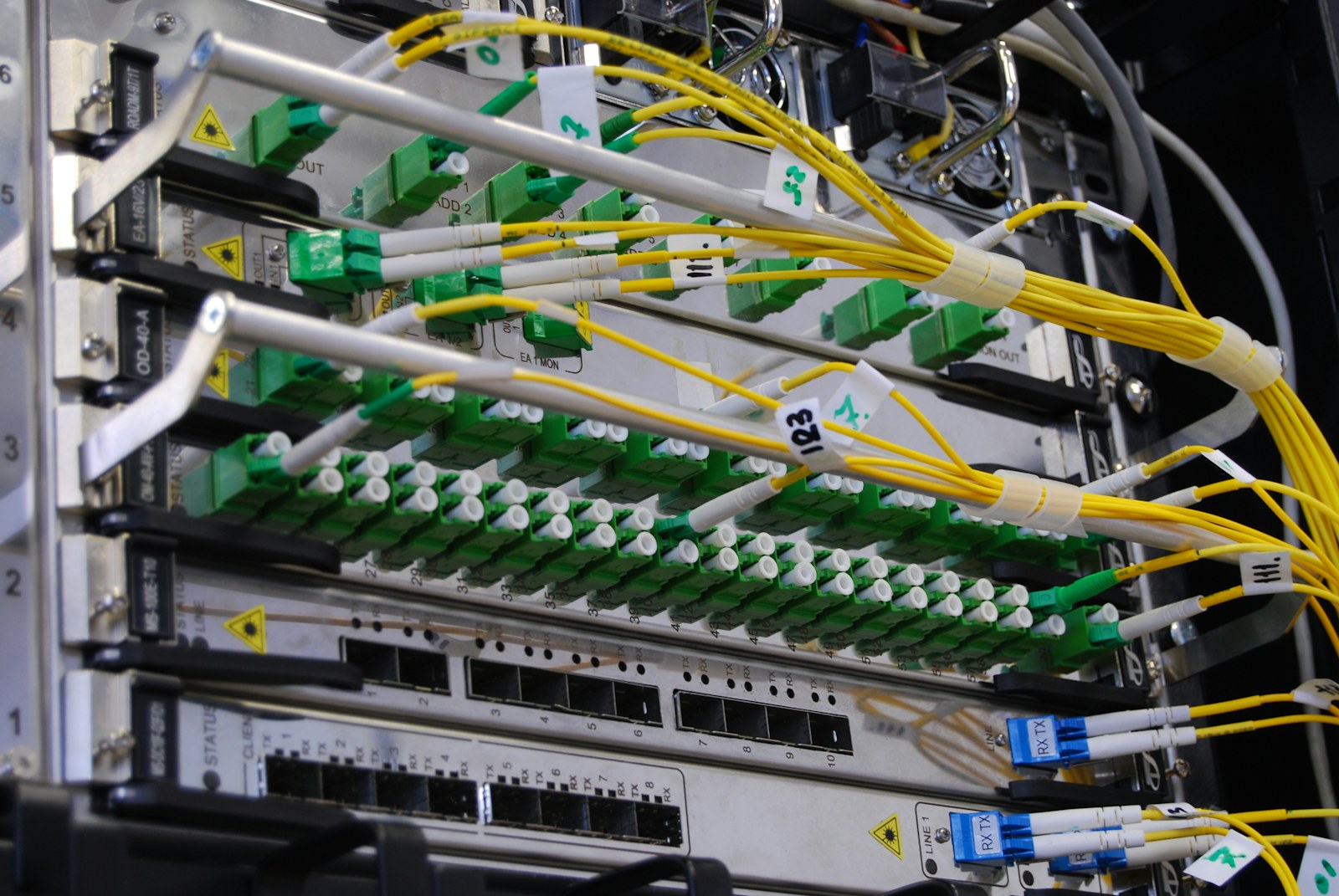
General orientation. Assess the specific project separately. Applies to: Readers comparing connectivity claims for Swedish halls and developments.
Reading order
Start with the building, not with the city. Ask how many diverse entries exist and who owns them. Ask which meet-me room is in this hall rather than in a campus next door. Ask which carriers have a physical presence in that room. Only then read a market sentence about Stockholm interconnection. A dense market can still leave a hall with one duct.
Then separate on-net exchange access from backhaul. Netnod and STHIX appear in Swedish interconnection conversation; being able to name them is not the same as having them in the building. Then read latency claims as either a measured path at a stated time or a straight-line estimate. Then, if the site is outside the Stockholm metro — Falun, Sollefteå, Luleå, Falkenberg, Staffanstorp — open a fiber file that does not reuse a Kista slide.
- Building entries and their owners, before carrier logos.
- Meet-me room in this hall versus a neighbour.
- On-net exchange versus backhaul.
- Measured latency versus a straight-line estimate.
Carriers, entries, rooms and exchanges
A carrier logo means that a company sells connectivity. It does not by itself mean that the company has a diverse physical path into the hall you are sitting in. Diversity is a property of ducts, risers and entries. Two contracts that share a street crossing are not two paths. Asking who owns the entry is therefore not a procurement nicety. It is the difference between a redundancy slide and a redundancy fact.
Meet-me rooms concentrate cross-connects. A campus can advertise a rich carrier set in one building while the hall under discussion is a remote cage with a single backhaul to that room. Conapto’s Stockholm south campus, Equinix Stockholm halls and atNorth’s SWE01 Stockholm metro site are different buildings with different rooms. Copying a carrier count from one onto another is a category error.
Internet exchanges are a further hop. On-net means the exchange fabric is in the building or is reached as if it were. Backhaul means you ride someone else’s path to get there. Latency numbers need a stated path and a stated time. A straight-line estimate between Luleå and Stockholm is a geometry exercise. It is not a measured circuit.
Stockholm versus the rest
Operator pages for Kista and inner-city halls describe rich carrier sets. Equinix publishes Stockholm data-center pages, including SK1 and SK2. Bahnhof publishes colocation pages and a named Pionen hall. GleSYS publishes a Stockholm site as well as Falkenberg. Those pages support the claim that Stockholm is a dense interconnection market. They do not invent a national fiber map, and they do not publish sensitive routes.
A development in Sollefteå or Falun needs its own fiber file. atNorth describes SWE04 at Sollefteå / Hamre Långsele as a 50 hectare development; that is a land sentence, not a carrier list. EcoDataCenter’s Falun campus is an operator power file first; connectivity still has to be asked for building by building. Meta’s Luleå campus and Microsoft’s sites in Gävle, Sandviken and Staffanstorp sit in other bidding areas and other municipalities. None of those operator rows is a substitute for the hall’s own entry drawing.
Falkenberg and Staffanstorp sit in SE4 and are not empty of halls. They are also not Kista. A west-coast or Skåne brochure that pastes a Stockholm exchange slide is doing the same category error as a northern brochure that pastes one. The connectivity question is local even when the cloud region name says Stockholm, and even when Microsoft named Staffanstorp in 2021.
What named primary sources show
Equinix’s Stockholm pages, including SK1 and SK2, are operator descriptions of those halls and of a Stockholm colocation market. They are not a route map and not a census of every carrier in SE3. atNorth’s SWE01 Stockholm metro pages describe that site. atNorth’s Sweden pages and the 2 September 2026 acquisition notice with CPP Investments and Equinix are ownership and platform facts. They do not merge SWE01 carrier language into SWE04 Sollefteå as if the metro slide travelled north.
Bahnhof’s colocation pages and the Pionen page are operator descriptions of those products and of a named inner-city hall. GleSYS’s Stockholm and Falkenberg pages show that one operator publishes more than one Swedish site. None of those pages is a substitute for an entry drawing, and none of them is reproduced here as a cable map. Detailed routes stay off this page on purpose.
Power sources in the same register — Svenska kraftnät’s map, EcoDataCenter’s Falun megawatt rows, Microsoft’s 2021 municipalities — answer electricity questions. They do not answer diversity of fiber into the building. A reader who treats a hydropower sentence in Luleå or a 41 MW balance-sheet sentence in Falun as a connectivity fact has left this note.
Common misreads
The first misread is to treat two logos as two ducts. The second is to treat a Stockholm market slide as the file for Falun, Sollefteå, Luleå, Falkenberg or Staffanstorp. The third is to treat a campus meet-me room as if it sat in every building on the campus. The fourth is to treat a region name — AWS Europe (Stockholm), Microsoft Sweden — as a published interconnect drawing.
The fifth is to treat an exchange name as on-net access. The sixth is to publish or demand a sensitive route map in a research note. This page will not draw those routes. The seventh is to treat the 2 September 2026 atNorth acquisition as if Equinix and atNorth halls had already become one carrier set. Ownership change is not a cross-connect.
What to ask
Write the answers into the hall file with dates. If a counterpart will not say who owns the second entry, record that as a gap. Do not fill the gap from an Equinix Stockholm page, a Bahnhof Pionen page, or an atNorth SWE01 page unless those pages are about this hall. Do not fill it from a power row in Falun or Luleå.
- How many diverse building entries exist, and who owns them?
- Which meet-me rooms are in this hall versus a campus next door?
- Is latency a measured path at a stated time, or a straight-line estimate?
- Which exchanges (for example Netnod or STHIX) are on-net versus reached by backhaul?
What this does and does not prove
This note proves that Swedish connectivity claims have to be read at building level, and that Stockholm density is not diversity at a named hall in Kista, south Stockholm, Falun, Sollefteå, Luleå, Falkenberg or Staffanstorp. It proves that Equinix, atNorth, Bahnhof and GleSYS pages are operator descriptions of their own sites. It proves that power rows and bidding areas do not answer fiber questions, and that this page will not publish sensitive routes.
It does not prove a carrier census for any hall. It does not prove a latency number. It does not prove that two logos are two paths. Those proofs require dated entry drawings, cross-connect lists and measured circuits. Until those papers exist, the honest label is that connectivity is still being asked for, including in Stockholm.
Sources
- Equinix Stockholm data centers — Equinix, 2026-01-01. Checked 2026-09-10.
- SWE01 Stockholm metro site — atNorth, 2026-01-01. Checked 2026-09-10.
- Bahnhof colocation and data centres in Sweden — Bahnhof, 2026-01-01. Checked 2026-09-10.
- Equinix SK1 Stockholm — Equinix, 2026-01-01. Checked 2026-09-10.
- Equinix SK2 Stockholm — Equinix, 2026-01-01. Checked 2026-09-10.
- Sweden data centers — atNorth, 2026-01-01. Checked 2026-09-10.
- CPP Investments and Equinix complete atNorth acquisition — atNorth, 2026-09-02. Checked 2026-09-10.
- Pionen — Bahnhof, 2026-01-01. Checked 2026-09-10.
- GleSYS Stockholm data center — GleSYS, 2026-01-01. Checked 2026-09-10.
- GleSYS Falkenberg data center — GleSYS, 2026-01-01. Checked 2026-09-10.